ARMY ACFT CALCULATOR
Contact UsARMY ACFT CALCULATOR
Contact UsThe Army Combat Fitness Test (ACFT) is designed to measure the physical readiness every soldier needs to fight and win in today’s operational environment. Whether you're in a combat arms role or a support MOS, your ACFT score reflects your ability to meet the demands of your duty.
The test consists of six events, each scored on a scale from 0 to 100 points, for a maximum possible score of 600. To pass the ACFT, you must:
Depending on your Military Occupational Specialty (MOS), you may fall into one of three physical demand categories, each with its own higher minimum requirements:
| MOS Category | Minimum Total Score | Minimum Per Event |
|---|---|---|
| Heavy (Black) | 440 points | 70 points |
| Significant (Gray) | 440 points | 65 points |
| Moderate (Gold) | 360 points | 60 points |
Each event’s scoring is also adjusted for age and gender, ensuring standards are fair across the force. So while the expectations remain high, they're tailored to reflect realistic performance across the Army’s diverse ranks.
This calculator will help you break down your results, understand where you stand, and build a plan to improve.
Summary:
The MDL evaluates lower-body strength and muscular endurance by measuring how much weight an individual can lift for three consecutive repetitions using a hex bar. This test simulates real-world lifting tasks and is a key component of the Army Combat Fitness Test (ACFT).
Action:
The participant lifts a loaded hex bar from the floor to a fully upright, locked-out standing position. The lift must be controlled, with the hips and shoulders rising simultaneously. Three repetitions must be completed consecutively without resting. Proper deadlift form is critical. Failure to maintain form invalidates the rep.
Equipment:

Summary:
The Standing Power Throw (SPT) assesses explosive power and total-body coordination by measuring how far a Soldier can throw a 10-pound medicine ball backward and overhead. This event replicates the dynamic lifting and throwing movements often required in combat and tactical environments. It is a critical component of the Army Combat Fitness Test (ACFT), evaluating a Soldier’s ability to generate force rapidly from the ground through the hips, core, and upper body.
Action:
The participant begins in a standing position at the designated throwing line, facing away from the direction of the throw. Holding the medicine ball with both hands, the Soldier performs a preparatory movement by hinging at the hips and lowering the ball between the legs, followed by an explosive upward and backward throw over the head. The throw must be executed in one fluid motion without stepping over the line. Two attempts are authorized, with the longest valid throw recorded.
Equipment:

Summary:
The HRP assesses upper-body muscular endurance, focusing on the chest, shoulders, and triceps. This event evaluates the ability to perform repetitive pushing movements under control, simulating tasks such as pushing obstacles, lifting equipment, or performing casualty drags. The HRP is a critical measure of combat readiness and functional upper-body strength.
Action:
The participant begins in the prone position with hands flat on the ground, arms extended, and body aligned. At the command of "GO," the Soldier lowers their body as a single unit to the ground until the chest, hips, and thighs touch the floor. Once in the down position, they lift both hands off the ground momentarily (hand release), then return them to the starting position and push up in a single, continuous motion to full arm extension. The body must remain rigid throughout the movement. Repetitions are counted only when properly executed. Rest is permitted only in the up position; any other form of rest or improper form results in termination of the event.
Equipment:

Summary:
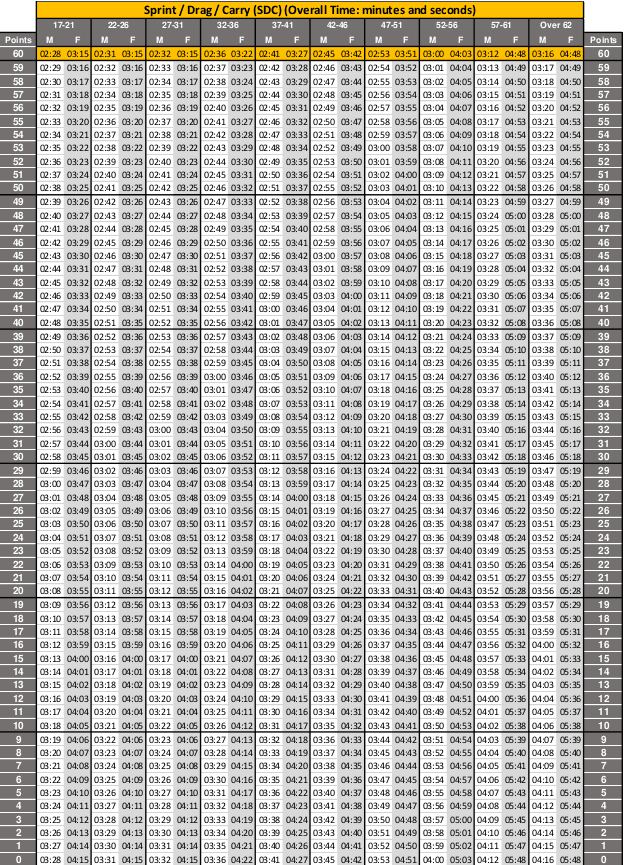
The SDC evaluates muscular strength, anaerobic power, agility, and coordination. This event simulates high-intensity, short-burst tasks commonly encountered in combat scenarios such as casualty extraction, equipment transport, and rapid movement under load. It is a critical assessment of a Soldier’s ability to perform functional, tactical movements in succession.
Action:
The event consists of five sequential 25-meter shuttles executed as follows:
The event is conducted for time. The Soldier must touch the line with one foot and hand at each turn. Failure to complete the event in sequence or maintain control of the equipment results in disqualification.
Equipment:

Summary:
The Plank assesses core strength and endurance, which are vital for maintaining stability, posture, and control during physically demanding tasks such as load carriage, climbing, and combative movements. This event measures the isometric endurance of the abdominal and spinal muscles critical for injury prevention and overall combat readiness.
Action:
The Soldier assumes a forearm plank position with elbows bent at 90 degrees, forearms flat on the ground, hands not clasped, and feet hip-width apart. The body must form a straight line from head to heels, with the hips neither sagging nor rising above the shoulders. The head remains neutral, and eyes are directed downward. The timer starts once the Soldier is in the correct position and stops when form can no longer be maintained or upon voluntary termination. Movement, excessive shaking, or any loss of alignment will result in event termination. Resting is not authorized.
Equipment:

Summary:
The Two-Mile Run evaluates aerobic endurance and cardiovascular fitness, which are essential for sustained physical activity during combat operations, foot marches, and extended missions. This event measures a Soldier's ability to perform continuous, moderate-to-high intensity physical exertion over time.
Action:
The Soldier must complete a two-mile distance on a measured, level running course as quickly as possible. The event begins from a standing start on the command "GO." Soldiers must remain on the designated course and maintain forward progress at all times. Pacing devices, unauthorized assistance, or deviation from the course will result in disqualification. The event concludes when the Soldier crosses the finish line, at which point time is recorded.
Equipment:

Below are the ACFT grading scales for different events. You can get the whole scoring table in pdf format here.